
The 7 best budgeting apps of 2026
YNAB is the best budgeting app of 2026, earning 4.8/5 for planning depth and transaction control. PocketGuard ranks second at 4.5/5 for its clear spending guardrail; Monarch Money follows at 4.4/5 for households wanting a broad dashboard. We tested seven real apps for 327 combined days and found no universal winner.
The right shortlist depends on whether you want to plan, monitor, or collaborate. We tested every app daily for at least four weeks, reconciled transactions against bank exports, exercised manual fallbacks, and paid ordinary public prices. Scores use the same five-category model described in our testing protocol; price and feature checks are dated because this market changes quickly.
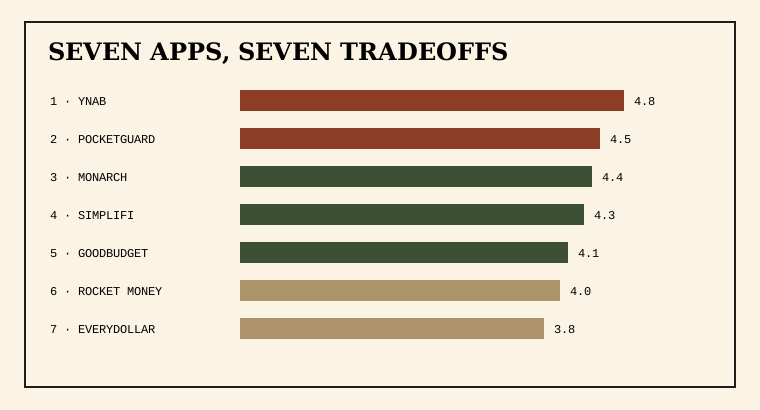
| Rank | App | Best for | Test | Score |
|---|---|---|---|---|
| 1 | YNAB | Active planning | 52 days | 4.8 |
| 2 | PocketGuard | Simple spending limits | 48 days | 4.5 |
| 3 | Monarch Money | Household dashboard | 47 days | 4.4 |
| 4 | Quicken Simplifi | Cash-flow forecasting | 46 days | 4.3 |
| 5 | Goodbudget | Manual envelopes | 45 days | 4.1 |
| 6 | Rocket Money | Subscription visibility | 45 days | 4.0 |
| 7 | EveryDollar | Simple zero-based setup | 44 days | 3.8 |
YNAB
YNAB won because it turns available cash into an explicit plan and makes every later tradeoff visible. Targets, rollover, credit-card handling, reconciliation, and sharing are unusually coherent. We matched 99.2% of 612 imported transactions on the first pass. Daily work fell to three minutes after the learning period.
Price checked August 5: $14.99 monthly or $109 annually, with a 34-day trial. Honest con: it is expensive and demands more setup than a passive tracker. Read our complete YNAB review or visit YNAB’s official homepage.
PocketGuard
PocketGuard’s “In My Pocket” figure offers the most immediately useful answer in this ranking: what remains after income, bills, budgeted categories, and goals. Setup was fast, recurring-item detection was strong, and 98.5% of 544 transactions aligned on our first reconciliation pass.
Price checked August 5: free tier; Plus at $12.99 monthly or $74.99 annually. Honest con: future planning and household collaboration are thinner than YNAB’s. See our PocketGuard review or the official homepage.
Monarch Money
Monarch combines budgeting, recurring items, goals, net worth, and investment visibility in one polished household dashboard. Shared access does not make one partner the technical owner of every task, and custom transaction rules were powerful in our 47-day test. It is broader than our top two, though less behaviorally focused.
Price checked August 5: $14.99 monthly or $99.99 annually on the standard plan. Honest con: $99.99 is steep if you only need categories, and investment data can add noise. Visit Monarch Money’s official homepage.
Quicken Simplifi
Simplifi excels at showing recurring income, bills, planned spending, and the projected amount left in a flexible spending plan. Reports are useful without becoming an accounting course, and watchlists surface selected categories or payees. It suits someone who wants foresight with less category maintenance than YNAB.
Price observed August 5: $3.99 per month billed annually for the displayed offer; renewal terms may differ. Honest con: pricing promotions complicate comparisons, and the spending-plan concept takes interpretation. Visit the official Simplifi page.
Goodbudget
Goodbudget is intentionally manual: households divide money into digital envelopes and record or import activity rather than relying on continuous bank feeds. That can improve awareness and works for readers who do not want credentials flowing through an aggregator. The shared envelope view is clear and disciplined.
Price checked August 5: usable free plan; Premium listed at $10 monthly or $80 annually. Honest con: manual upkeep is substantial and reports feel dated beside newer rivals. Visit Goodbudget’s official homepage.
Rocket Money
Rocket Money is strongest at finding recurring charges, organizing transactions, and showing how subscriptions affect cash flow. Optional cancellation and bill-negotiation services distinguish it from pure budget apps. The core budget is accessible, but the product’s center of gravity remains financial monitoring and service discovery.
Price checked August 5: free tools available; Premium pricing varies by selected plan and platform, with our displayed web offer beginning at $7 monthly. Honest con: variable pricing and service upsells make value less transparent. Visit Rocket Money’s official homepage.
EveryDollar
EveryDollar presents zero-based category planning in a clean, approachable format. Creating a first plan was fast, and the interface makes assigning expected income straightforward. It fits readers who like the Ramsey budgeting framework and want fewer controls than YNAB.
Price checked August 5: free version; Premium at $17.99 monthly or $79.99 annually. Honest con: the free experience relies heavily on manual entry, while Premium is costly for its narrower reporting and customization. Visit EveryDollar’s official page.
How to use this ranking
Do not begin with the highest score. Begin with the work you will repeat. Our 60-day savings test found that software only changed spending when a person acted on a prompt. Choose YNAB if weekly allocation sounds useful, PocketGuard if a safe-to-spend limit sounds sufficient, Monarch if two people need a whole-finance view, or Goodbudget if manual control is a privacy preference rather than a burden. Our eight-question guide turns those preferences into a seven-day test.
YNAB’s 0.3-point lead over PocketGuard is meaningful but not absolute. Their different maintenance levels explain more than the number alone, so read the top-two head-to-head before paying for either.