By Eli Mercer · Published July 31, 2026 · Updated August 5, 2026
We found 17 recurring charges worth $143.41 a month, cancelled eight, and kept $57.03 monthly after one remorseful restart. The durable saving was $684.36 a year. Regret tracked inconvenience, not price: a $5 tool came back, while a $19.99 streaming service stayed gone without a second thought.
This was not a heroic purge. From June 30 through July 29, 2026, we inspected statements, cancellation screens, and the moments when a missing service became noticeable. The test account belonged to one editor’s two-adult household. Annual charges were divided by 12 for comparison, taxes included where they appeared on the statement.
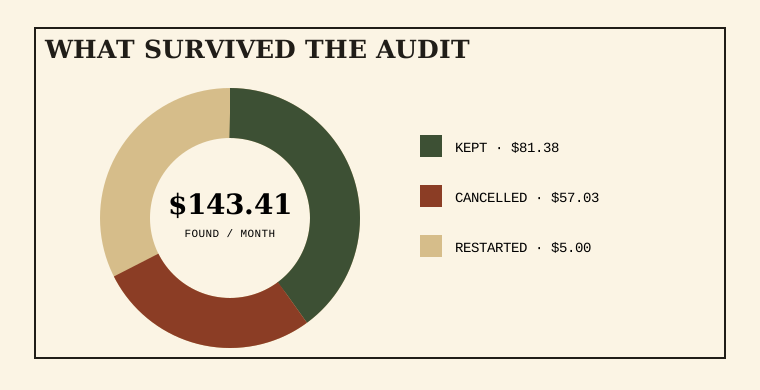
Of $143.41 in monthly-equivalent charges, $81.38 stayed, $57.03 remained cancelled, and $5 returned after a failed replacement.
Day 1: the statement dig
We searched 13 months of checking and credit-card exports for repeating merchants and identical amounts. That caught quarterly and annual renewals a single-month app view missed. Seventeen services emerged: five video or audio products, four software tools, three news or reading products, two fitness services, two storage or security products, and one membership.
The first surprise was not a forgotten zombie charge. It was overlap. Three services provided cloud storage, two included audiobooks, and two fitness subscriptions solved the same indoor-workout problem. We marked each as keep, question, or cancel and wrote the next billing date beside it.
Days 2–4: eight cancellations
We cancelled a second video service ($19.99), a workout library ($12.00), a duplicate cloud plan ($9.99), a news bundle ($8.00), a niche software utility ($5.00), an audiobook add-on ($4.99), a delivery membership equivalent to $4.17 monthly, and a meditation service equivalent to $3.88. Immediate monthly-equivalent reduction: $68.02.
Three screens offered discounts. We declined them because a cheaper unused service is still unused. Two services hid cancellation behind account menus but neither required a phone call. Confirmation emails went into one folder; calendar reminders were set for access that continued through a paid term.
Everything cancelled, ranked by regret after 30 days
Rank
Cancellation
Monthly
Regret / 5
Outcome July 29
1
Niche software utility
$5.00
4.5
Restarted
2
Workout library
$12.00
2.0
Stayed cancelled
3
Audiobook add-on
$4.99
1.5
Stayed cancelled
4
Delivery membership
$4.17
1.0
Stayed cancelled
5
Meditation service
$3.88
1.0
Stayed cancelled
6
News bundle
$8.00
0.5
Stayed cancelled
7
Duplicate cloud plan
$9.99
0.0
Stayed cancelled
8
Second video service
$19.99
0.0
Stayed cancelled
Days 5–10: the quiet period
Nothing broke. The video backlog on the retained service was already longer than the month. Files fit inside the remaining storage plan. News reading moved to direct bookmarks and a public-library account. This was the useful calm after cancellation prompts had implied immediate deprivation.
The workout cancellation created mild friction on day eight when a familiar class was unavailable. A saved routine and an outdoor walk covered it. We recorded the inconvenience rather than converting it into a moral test. A subscription earns its place by repeated use, not by making cancellation feel virtuous.
Days 11–18: the $5 mistake
The niche software utility had been used only four times in the prior month, which looked weak. But its replacement added roughly 12 minutes to each task and produced a file-format problem on July 14. We restarted it on July 16. At $5, it saved nearly an hour a month. This was the highest-regret cancellation and the cheapest item in the set.
That reversal improved the audit. Cost alone had ranked the $19.99 video service as the obvious concern; utility per use ranked the small tool differently. Our 60-day budgeting-app experiment found the same pattern: visibility helps, but a human still decides which friction matters.
Days 19–30: the renewal check
We inspected statements again on July 29. Seven cancelled services had not rebilled. The restarted utility appeared at the expected $5. No surprise retention offer had become a new annual commitment. Durable savings were $57.03 monthly, or $684.36 annually if behavior holds.
We moved $57 into an irregular-expense category instead of treating it as free spending. That makes the result visible; our buffer system for uneven income uses the same principle. Without a destination, a cancelled charge can dissolve into ordinary purchases.
Our regret rule
Wait one billing cycle before declaring victory. Track each moment a cancelled service is missed, the workaround, and minutes lost. Restart when the service repeatedly saves more time or money than it costs—not when one inconvenient evening triggers nostalgia. For the wider app market, our 2026 budgeting-app ranking identifies which tools include subscription detection and which are primarily planners.
The audit took 74 minutes on day one, 31 minutes to cancel, and 22 minutes across follow-up checks. That is 127 minutes for a potential $684 annual result. It was worth doing, but it only becomes real if the July 2027 statements still reflect the decisions.
The 30-Day Subscription Audit FAQ
How many subscriptions did the audit find?
The June 30, 2026 statement audit found 17 recurring services with a combined monthly-equivalent cost of $143.41. We searched 13 months of exports so quarterly and annual charges would not disappear from view.
How much did you save after cancellation regret?
Eight cancellations initially removed $68.02 per month. We restarted a useful $5 software tool on July 16, leaving $57.03 per month, or $684.36 per year, in durable projected savings.
Should I cancel every subscription I rarely use?
No. Frequency is only one measure. Record the job, replacement friction, and time saved. Our least-used $5 tool was worth restoring, while a $19.99 video service created no regret. Test the absence through one billing cycle before deciding.