Irregular Income, Regular Bills: A Buffer That Works
By Eli Mercer · Published July 22, 2026 · Updated August 5, 2026
The buffer worked because it converted uneven client payments into a fixed $3,600 monthly transfer. In our January–June 2026 case, income ranged from $2,900 to $6,800, yet every regular bill cleared on time and the operating buffer ended $2,140 higher. The crucial number was the $4,700 floor, not average income.
Freelance advice often says to “save in good months,” which is directionally correct and operationally vague. This system uses three accounts, one conservative monthly pay figure, and two trigger levels. The example is a self-employed designer with $5,400 in starting business cash on January 1, 2026 and no employees. Figures are rounded but taken from the actual six-month ledger.
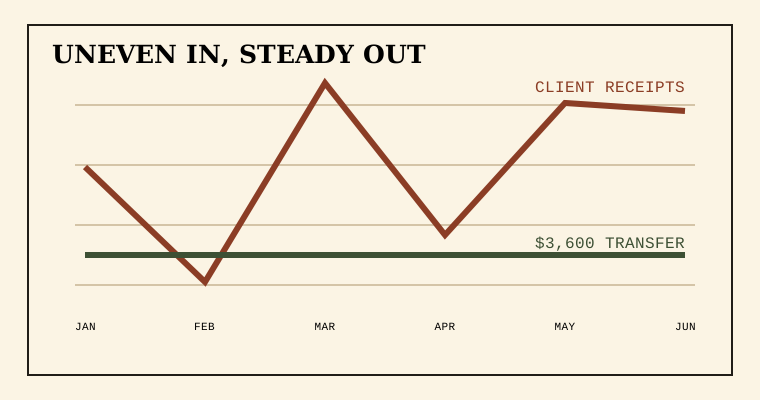
Client receipts moved sharply; the household transfer did not. Excess stayed in the operating buffer until trigger dates.
Start with the weak month, not the average
Average monthly receipts for the prior 12 months were $5,180. Using that as spendable income would have failed in February, when only $2,900 arrived. We instead chose a $3,600 household transfer based on the lowest repeatable client workload and essential personal costs. Rent, utilities, insurance, groceries, and minimum commitments totaled $3,070, leaving $530 for variable spending and personal sinking funds.
The business account retained incoming client payments. On the first of each month, exactly $3,600 moved to household checking. A separate tax savings account received 27% of every client payment on arrival. The percentage is specific to this case and is not tax guidance; location, deductions, entity, and total income change the obligation.
Six months of uneven income and regular transfers
2026 month
Client receipts
Tax set-aside
Household transfer
Operating buffer end
January
$5,200
$1,404
$3,600
$5,596
February
$2,900
$783
$3,600
$4,113
March
$6,800
$1,836
$3,600
$5,477
April
$4,100
$1,107
$3,600
$4,870
May
$6,400
$1,728
$3,600
$5,942
June
$6,300
$1,701
$3,600
$6,941
The three-account map
Operating received client money and paid business costs. Tax held the percentage transfer and was never treated as a buffer. Household received the fixed monthly amount and paid personal bills. This separation stopped a $6,800 month from looking like permission for a $6,800 lifestyle.
Inside household checking, categories divided the $3,600 transfer. Regular bills received $2,240, groceries and transport $680, personal sinking funds $430, and flexible spending $250. When a client paid late, the household did not need to rearrange rent because the transfer came from the operating buffer.
The $4,700 floor
The lower trigger was $4,700: one $3,600 household transfer plus $1,100 of average business operating costs. When the buffer fell below that number at the end of February, three rules activated. Optional business equipment paused, no extra household transfer was allowed, and new project deposits received priority follow-up. The system did not cut the already planned March household amount.
The upper trigger was $8,300, equal to two household transfers plus one month of business costs. Cash above it at a month-end review could be divided among retirement saving, additional personal buffer, or a business investment. The account never reached that level during this six-month window, so there was no distribution.
Invoice timing still matters
A buffer absorbs timing; it does not excuse weak collection. Invoices went out every Friday, deposits were required for projects over $1,500, and follow-ups occurred at 3, 10, and 20 days past due. On June 12, 2026, one $2,100 invoice was 17 days late. The buffer prevented a bill problem, while the follow-up process addressed the client problem.
We logged expected payments separately from cash available. Forecasts helped anticipate, but only cleared money funded the household transfer. This matches the available-cash logic in our month-long YNAB rules case study, though the system can run in a spreadsheet or at a bank.
How to size your own fixed transfer
Take the lower of two numbers: conservative net receipts after business costs and tax set-asides, or essential household spending plus a modest variable allowance. Test it against the three weakest months in the last year. If the starting buffer would fall below one future transfer, reduce the amount or build the buffer before pretending it is pay.
Do not hide annual personal costs. The $430 sinking-fund allocation included vehicle maintenance, health costs, gifts, and annual insurance. Our 90-day grocery receipt study also helped set the $480 food target from evidence rather than a round guess.
What six months proved
Total client receipts were $31,700. Tax transfers were $8,559, household transfers were $21,600, and the operating buffer rose from $5,400 to $6,941 before small timing adjustments, with $599 of net business expenses reflected across the period. Every personal bill cleared by its due date. The worst month used $1,483 of buffer; the strongest rebuilt it.
The system’s weakness is obvious: it needs starting cash. Someone beginning with no buffer cannot smooth a weak month by labeling an empty account. Build the first floor with smaller fixed transfers, deposits, and retained strong-month cash. For help choosing software versus a sheet, use our workflow-first budgeting guide. The mechanism matters more than the app.
Irregular Income, Regular Bills FAQ
How large should a freelancer income buffer be?
A practical first floor is one fixed household transfer plus one month of essential business costs. In this case that was $4,700: $3,600 for the household and $1,100 for operations. A larger buffer may be necessary with seasonal work or concentrated clients.
Why not budget from average freelance income?
An average can be unavailable when bills are due. This case averaged more than $5,000 in receipts but had a $2,900 February. A conservative fixed transfer and retained operating cash made the timing mismatch manageable.
Should tax savings count as part of the buffer?
No in this system. Twenty-seven percent of each payment moved to a separate tax account and was excluded from spendable operating cash. The correct rate and payment schedule depend on individual circumstances and jurisdiction.